Wine and cuisine are themes so richly suggestive that seem to be two inexhaustible strands of commercial narrative. Cyclically one wonders about long-term market trends
Winemakers wonder whether they will be able to maintain the interest of new generations of consumers alive.
In between fruits and roots, the branches
If we compare the agricultural industry of the Bel Paese to a luxurious tree, we recognise its finest fruits in recipes and products with designation of origin: wine, cheeses, cured meats and many other gastronomic preparations. We also know that this symbolic tree is rooted in ‘household traditions’ and in ancient knowledge of the Italian province. Lastly, the branches, reaching out towards light and growth, are the new generations that will appreciate our food and wine specialities in their adult life as consumers.
Sometimes the beautiful evocation behind designations of origin contains a few forcings. In short, neither wine, cheeses or cured meats are exactly produced as it was done in the Medieval time or even a hundred years ago. Technology has given to winemakers, craftsmen of taste and cheesemakers instruments for analysis and control of yeast and bacteria. Refrigeration and automatic temperature control in many processes, unthinkable until fifty years ago, have improved the delicacy of aromas and harmony of taste. The fruit of the earth is no longer just nourishment, it has become pleasure. In case of wine, specifically, in the last decades we have seen a proliferation of amateur approaching courses to national wines. Many know how to discuss descriptors, swirl a glass to oxygenate the wine and ask the winemaker questions. This ‘knowledge’ also improved inter-regional exchange, mentally opening up opportunities to try unfamiliar labels from other regions. How much of this interest will be passed on to new generations of consumers?

The market situation
We are witnessing a general decline in global wine consumption. Although there is news about authorisation procedures for the uprooting of significant areas of vineyard land in the French region of Bordeaux, at the moment the situation of the Italian vineyard doesn’t look so worrying. In Italy, the trend sees the consumption of wine ‘outside the home’ prevailing; the average daily bottle per family has definitely been replaced by 3 or 4 glasses per week, mostly consumed ‘outside the home’. In this regard, the Nomisma Wine Monitor institute commented a few days ago: “the holding of restaurants is a breath of fresh air for small wineries, often tied to the local area’.
Nevertheless, the concerns of manufacturers remain. Many foreign markets, for different reasons, are reducing the amount of wine imported from Italy. We have also become familiar with the so-called neo-prohibitionism, that media phenomenon for which some campaigns that raise awareness of the responsible use of alcohol have resulted in direct attacks on wine, ostracising it in any quantity or context.
The communication model
Since the 1980s until now, the trend in Italian wine consumption has gradually increased in awareness and quality. The rediscovery of autochthonous varieties and the effect of soil and microclimate has been the winning arguments, as well as cultural identity of regions and family histories of the winemaker. However, it must be said that ‘a generation goes, a generation comes…’ and these were the topics of interest for the so-called generations X and Y. A new age group of customers has now entered direct consumption of the fruit of the vine. Are autochthonous, terroir and family still the narrative topics to engage the interest of generation Z consumers?
In the Country of hundreds of thousands of bell towers, the disproportionate number of Doc and Docg wines that have been decreed certainly does not help in the task of communicating the subject to 25-year-olds. Those who today are used to questioning a search engine by voice command are no doubt sensitive to languages other than those traditionally used by wineries. Many winemakers hope that their own consortium’s communication plan is sufficient and this makes their personal communication listless, even a little lazy. On the other hand, creating stimulating and non-trivial content for the most popular social channels takes a lot of effort; a few hours, every day and a lot of creative energy!
The new generations
In this current ocean of labels, all different in theme, design and colour … what elements are the senses of digital natives attentive to? The languages of communication evolve naturally, following the market and chasing innovation. Even wine lists change with time. The success of Prosecco has changed the assortment of wine lists and board list, which include more and more sparkling and white wines.
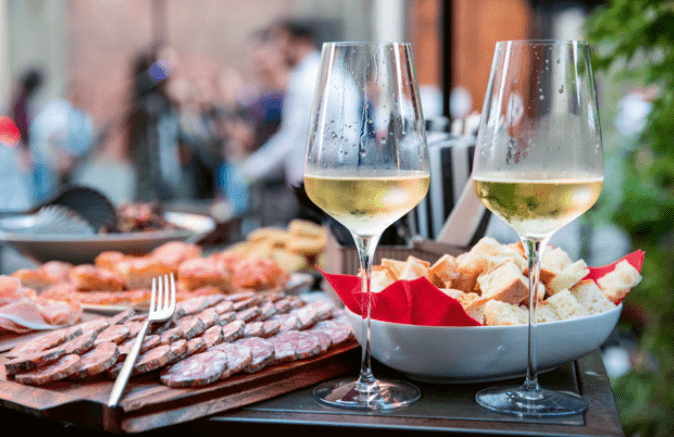
There is another change taking place, led by 20-year-olds living in big cities. Many of the very young people approaching wine have neither the money nor the desire to frequent the traditional wine shop with kitchen or the more refined terraces. In Rome, for example, strolling in the evening in front of Vesper (a club in the Nomentano area) one will spot dozens of young people on the sidewalk. They are outside costumers of the same venue that has a few tables inside. In essence, at Vesper in Rome, generation Y sits inside, while generation Z stands outside with a glass of wine in their hand. The vanguard of this mode of consumption is, again in Rome, the microscopic Angolo Trieste. Wines by the glass and very few snacks served from a counter/window to dozens and dozens of young people standing on the sidewalk across. Two tales of how the new generations are seeking a more immediate, less expensive and less ‘cast-off’ mode of wine consumption than sitting at a table, with menu and service.
Hurry to consume? Superficiality? Not necessarily. On the one hand, it is true that this consumption is more absent-minded and there is no time or environment to dissect the descriptors of a wine or its terroir, but on the other hand, wine has lightly returned to the centre of sociality, a true element of aggregation and conviviality.
Interesting.
It is in this context that operators throughout the supply chain, winemakers first and foremost, ask themselves about consumption trends. Their questions and concerns are legitimate; any corrective actions in production schedules require long response times that entrepreneurs in other sectors cannot even imagine. Only a family that runs a farm is aware of the fact that, before a vineyard can be converted to the production of a new variety, it takes years and substantial investments. It is also true that the more expensive and refined wines, wines from Nebbiolo for example, have always been arrival wines for the average consumer.
It is therefore probable to imagine that the 25-year-olds of today will find themselves in about fifteen years to have matured their personal taste. If they have some extra financial security, they will be able to access more complex and demanding consumption. A kind of ‘spinning wheel’, an evolutionary scale of consumption.
At this point, stories about grape varieties and the identity of territories could be the leitmotiv that keeps generations of winemakers and lovers of quality bottles together. A reflection could be made by the producers of the most expensive and renowned wines: is it wise to invest in a brand promotion specifically aimed at 20-year-olds, the future customers of their more structured wines? So-called brand awareness, the knowledge of a brand by a specific consumer group, can accompany the customer through all its growth stages, from a beginner and curious 20-year-old to a knowledgeable 40-year-old. Neuromarketing is yet to be explored. It can be drawn upon with both hands for the creation of labels, images, corporate videos, shelf positioning and the creation of communicative messages. Few communication professionals have already explored the use of artificial intelligence as a co-author in the creation of popular and promotional content aimed at younger consumer groups. Marketing will try to adapt products and messages to the new generations: after Z. It starts again with Alpha.
Marco Negro
May 2024